


Métodos numéricos/Equações não lineares
Introdução[editar | editar código-fonte]
Os métodos descritos neste capítulo permitem obter, por um processo iterativo, uma solução de uma equação onde fornecendo uma aproximação inicial . Obtém-se um sucessão de pontos tal que quando e .

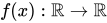


- Definição
- Diz-se que é uma raiz da equação se .

Iterações, ordem de convergência e constante assimptótica de erro[editar | editar código-fonte]
- Definição
- Seja uma sucessão de pontos tal que quando e e duas constantes , . Se o limite existe


Então diz-se que a sucessão de pontos dada converge para com ordem de convergência e constante assimptótica de erro .
Um método iterativo diz-se com convergência linear se , com convergência supra linear se e com convergência quadrática se .


- Exemplo
- Considere-se as seguintes sucessões:
Este exemplo precisa de ser melhorado!
,

,

, para as quais se tem
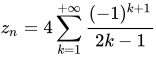
,

e

.

Pode então construir-se a seguinte tabela de valores para cada uma das sucessões:


E estimar quanto vale a constante assimptótica de erro através da expressão
. Para obtém-se
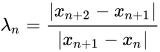


A tabela anterior mostra que as sucessões têm uma convergência linear () com uma constante assimptótica de erro próxima de um, têm por isso uma convergência muito lenta.
Critérios de parada[editar | editar código-fonte]
Os métodos que serão expostos nas seções seguintes permitem obter uma sucessão de valores que aproximam sucessivamente o zero de uma função. De modo a definir um critério que permita aferir qual a exatidão da aproximação obtida é usual terminar o algoritmo que calcula cada aproximação através da verificação das seguintes condições, dado um :

- i.
- ii.
- onde ,
- iii.
- .

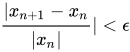


A estas condições é necessário adicionar ainda a condição onde é o número máximo de iterações.


Método da bissecção[editar | editar código-fonte]
Código em Octave[editar | editar código-fonte]
function bf=bissec(a,b,Niter,tol)

format short g;
disp("")
disp ("Resultado do metodo da bisseccao")
disp("")
disp ("           n           a           b           x         f(x)")
fa=f(a);
for i=1:1:Niter
  fb=f(b);
  x=a+(b-a)/2;
  fx=f(x);

  disp ([i, a, b, x, fx]);
  if (fx==0 |(b-a)/2<tol)
    disp("")
    disp ("O metodo foi aplicado com sucesso!")
    disp("")
    return;
    else
      if (fa*fx>0)
      a=x;
      fa=fx;
    else
      b=x;
    endif
  endif

endfor
disp("")
disp ("O metodo falhou depois da iteracao (Niter)")
disp (Niter)
disp("")
endfunction
Com a função
function fv = f(x)
x*ln(x) - 3.2;
endfunction
Para correr o programa fazer
- Input
bissec(2,3)
e gera o
- Output
Resultado do metodo da bisseccao

           n           a           b           x         f(x)
           1           0           3         1.5     -1.4293
           2           0         1.5        0.75   -0.018311
           3           0        0.75       0.375     0.55551
           4       0.375        0.75      0.5625     0.28342
           5      0.5625        0.75     0.65625     0.13604
           6     0.65625        0.75     0.70312      0.0597
           7     0.70312        0.75     0.72656      0.0209
           8     0.72656        0.75     0.73828   0.0013451
           9     0.73828        0.75     0.74414  -0.0084704

O metodo foi aplicado com sucesso!
No caso de o número de iterações não seja suficiente o resultado é este
- Input
bissec(2,3)
- Output
Resultado do metodo da bisseccao

           n           a           b           x         f(x)
           1           0           3         1.5     -1.4293
           2           0         1.5        0.75   -0.018311
           3           0        0.75       0.375     0.55551
           4       0.375        0.75      0.5625     0.28342
           5      0.5625        0.75     0.65625     0.13604

O metodo falhou depois da iteracao
         5
Método de Newton[editar | editar código-fonte]
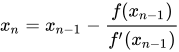
Zeros simples[editar | editar código-fonte]
,

Zeros múltiplos[editar | editar código-fonte]
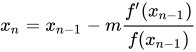
, onde é a multiplicidade da raíz.

Método da secante[editar | editar código-fonte]
Implementação em Octave[editar | editar código-fonte]
Com a mesma f.m definida anteriormente.
function sf=secant(x,y,Niter,tol)

format short g;
disp("")
disp ("Resultado para o metodo da secante")
disp("")
disp ("           n          x         err        f(x)")

for i=1:Niter
  if (f(x)==0 |abs(x-y)<tol)
    disp("")
    disp ("O metodo foi aplicado com sucesso!")
    disp("")
    return;
  else
    epsilon=abs(f(y)*(y-x)/(f(y)-f(x)));
    disp ([i, y, epsilon, f(y)]);
    oldx=y;
    y=y-f(y)*(y-x)/(f(y)-f(x));
    x=oldx;
  endif
endfor

disp("")
disp ("O metodo falhou depois da iteracao (Niter)")
disp (Niter)
disp("")
endfunction
- Input
secant(.2,.3,15,.01)
- Output
Resultado para o metodo da secante

           n          x         err        f(x)
           1         0.3      0.5254     0.65534
           2      0.8254    0.096338    -0.14714
           3     0.72907   0.0098364    0.016732

O metodo foi aplicado com sucesso!
Método da falsa posição (Regula falsi)[editar | editar código-fonte]
Implementação em Octave[editar | editar código-fonte]
Com a mesma f.m definida anteriormente.
function rff=regulafalsi(x,y,Niter,tol)

format short g;
disp("")
disp ("Resultado para o metodo da falsa posicao")
disp("")
disp ("           n          x          y         err        f(x)")


for i=1:Niter
  oldy=y;
  y=y-f(y)*(y-x)/(f(y)-f(x));
  if (f(y)==0 |abs(y-oldy)<tol)
    disp("")
    disp ("O metodo foi aplicado com sucesso!")
    disp("")
    return;
  else
    epsilon=abs(x-y);
    disp ([i,x, y, epsilon, f(y)]);
    if (f(oldy)*f(y)<0)
      x=oldy;
    else
    endif
  endif
endfor

disp("")
disp ("O metodo falhou depois da iteracao (Niter)")
disp (Niter)
disp("")

endfunction
- Input
regulafalsi(.2,1,100,.001)
- Output
Resultado para o metodo da falsa posicao

           n          x          y         err        f(x)
           1         0.2     0.70336     0.50336    0.059306
           2           1     0.73726     0.26274   0.0030522
           3           1     0.73899     0.26101   0.0001531

O metodo foi aplicado com sucesso!
Método da falsa posição modificado[editar | editar código-fonte]
- PASSO 1
Faça i = 1
- PASSO 2
Enquanto i £ ITMAX, execute os passos 3 – 6
- PASSO 3
Faça p = f( p) (calcular pi )
- PASSO 4
Se 0 p - p < e então Saída ( p ) (procedimento efetuado com sucesso) FIM
- PASSO 5
Faça i = i + 1
- PASSO 6
Faça p0 = p (atualize p0 )
- PASSO 7
Saída (solução não encontrada após ITMAX iterações)
- FIM
Método do ponto fixo[editar | editar código-fonte]
i) f e f' são funções contínuas em I; ii) = f ( ) <1 Î k x x I max ' iii) x0 ÎI e xn+1 = f(xn )ÎI , para n = 0, 1, 2, ¼ Então a seqüência { } xn converge para o zero a .
Implementação em Octave[editar | editar código-fonte]
Com a função g.m definida por:
function gv = g(x)

  gv=cos(x);

endfunction
function sfp=fpoint(x,Niter,tol)

format short g;
disp("")
disp ("Resultado para o metodo do ponto fixo")
disp("")
disp ("           n          x          err        g(x)")

for i=1:Niter
  oldx=x;
  x=g(x);

  if (g(x)==x |abs(x-oldx)<tol)
    disp("")
    disp ("O metodo foi aplicado com sucesso!")
    disp("")
    return;
  else
    epsilon=abs(x-oldx);
    disp ([i,x, epsilon, g(x)]);
  endif

endfor

disp("")
disp ("O metodo falhou depois da iteracao (Niter)")
disp (Niter)
disp ("iterations")
disp("")

endfunction
- Input
fpoint(.2,100,.01)
- Output
Resultado para o metodo do ponto fixo

           n          x          err        g(x)
           1     0.98007     0.78007     0.55697
           2     0.55697      0.4231     0.84886
           3     0.84886     0.29189     0.66084
           4     0.66084     0.18802     0.78948
           5     0.78948     0.12864     0.70422
           6     0.70422    0.085263     0.76212
           7     0.76212    0.057904     0.72337
           8     0.72337    0.038745     0.74958
           9     0.74958    0.026202     0.73198
          10     0.73198    0.017599     0.74385
          11     0.74385    0.011877     0.73586

O metodo foi aplicado com sucesso!

|
Esta página é um esboço de matemática. Ampliando-a você ajudará a melhorar o Wikilivros. |