


Medida e integração/Imprimir

Prefácio
Este material está sendo elaborado com base nas notas de aula da disciplina Medida e Integração, do programa de Doutorado em Matemática do IME, ministrada pelo professor Alfredo Jorge Aragona Vallejo, no primeiro semestre letivo do ano de 2009.
O conteúdo do livro não precisa (nem deve) se limitar àquele que consta atualmente no índice. Sendo assim, a qualquer momento o livro pode ser revisto e ampliado.
Sinta-se a vontade para ler este ou quaisquer outros livros do projeto, melhorando-os conforme lhe for possível. Com isso estará ajudando a aumentar a quantidade e a qualidade dos textos didáticos disponíveis em língua portuguesa, ao mesmo tempo em que colaborará com o crescimento projeto Wikilivros como um todo.
Se tiver dúvidas ou sugestões sobre páginas específicas, utilize as páginas de discussão correspondentes para deixar um comentário a respeito.
Ainda há muito por fazer, mas cada um daqueles que contribuem acredita estar fazendo o possível para oferecer o melhor a todos.
Notações
No decorrer deste texto algumas notações serão usadas com bastante frequência. Por este motivo, este capítulo é destinado a esclarecer tais notações.
Conjuntos numéricos[editar | editar código-fonte]
Os conjuntos de números mais conhecidos serão denotados de maneira usual:
- é o conjunto formado pelos números que se usa para contar, ou seja, os números naturais:
- é o conjunto que contém todos os números inteiros, ou seja, os números naturais e seus opostos:
- é o conjunto formado pelos números racionais, ou seja, as frações positivas e negativas com numerador e denominador inteiros:
- denota o conjunto dos números reais, que é formado pela união dos números racionais com os números irracionais;
- denota o corpo dos números complexos;








Adicionalmente, quando for mencionada uma propriedade que vale tanto para o corpo quanto para o corpo será usada a notação para não ser necessário mencionar ambos os conjuntos. Sendo assim, sempre que você encontrar ao longo do texto, lembre-se que o mesmo pode ser trocado por ou por sem prejuízo algum.


Operações entre conjuntos[editar | editar código-fonte]
Às vezes, ao se definir um conjunto (ou um conceito qualquer ) em termos de uma expressão , é conveniente abreviar a afirmação " é definido como sendo " denotando-a simplesmente como:


- .

Em alguns livros, você pode encontrar também as notações e mas neste texto elas não serão utilizadas.


Se for qualquer um dos conjuntos ou indica-se que o zero foi removido de tal conjunto usando-se a notação Em símbolos, isto se expressa como:



Se e são conjuntos, então:
- denota a cardinalidade do conjunto (ou a quantidade de elementos em ). Quando é finito, escreve-se ;
- é a interseção dos conjuntos e
- é a união dos conjuntos e
- denota a diferença entre os conjuntos e
- Se o conjunto é chamado de complementar de em relação a e passa a ser denotado por No entanto, alguns autores[1] preferem manter a notação
- Quando ficar claro pelo contexto qual é o conjunto pode-se omiti-lo na notação Nesses casos, escreve-se apenas (o complementar de ). Com esta notação, tem-se Em alguns livros, encontram-se também as notações ou ainda [2]
- é a diferença simétrica entre e
- é o conjunto das partes de ou seja, o conjunto dos subconjuntos de
- é o conjunto das partes finitas de















Se e são conjuntos não-vazios, então uma família em indexada por é simplesmente qualquer aplicação Os elementos de são chamados de índices e conjunto é então um conjunto de índices. A família é denotada por ou, quando o conjunto de índices ficar claro pelo contexto, simplesmente por





Alguns autores preferem usar ou no lugar de Ocasionalmente isto poderá acontecer ao longo deste wikilivro.


Se é enumerável, ou seja, se existe uma correspondência biunívoca de com a família é chamada de sequência em indexada por . Se é finito, a família é chamada de sequência finita em indexada por

Se é uma família em indexada por enumerável ou não, então:

- A união arbitrária dos quando percorre é o conjunto


- A intereseção arbitrária dos quando percorre é o conjunto

Se , a união arbitrária dos quando percorre é


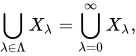
e a intereseção arbitrária dos quando percorre é
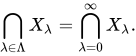
Analogamente, se , então:


Do mesmo modo, escreve-se

Se então e


Referências[editar | editar código-fonte]
Mensurabilidade
Introdução[editar | editar código-fonte]
Nos cursos básicos de cálculo, aprende-se que a integral está intimamente relacionada com a noção de área que se conhece desde o ensino fundamental. A teoria da integração tem em suas raízes os trabalhos de matemáticos gregos como Eudoxo e Arquimedes, que viveram alguns séculos antes de Cristo.[1] Naqueles tempos, eles já eram capazes de calcular áreas e volumes por meio do método de exaustão, no qual se decompunha um todo em infinitas partes cuja área ou volume fossem quantidades conhecidas.
O maior avanço em relação a integração veio somente no século XVII, com a descoberta do teorema fundamental do cálculo, feita independentemente por Newton e Leibniz. No entanto, mesmo nesta época a teoria da integração carecia de uma formulação rigorosa. Foi Riemann quem, no século XIX, trouxe uma formalização da noção de integral através do uso de limites. Hoje em dia, os cursos de cálculo trazem tradicionalmente as ideias e propriedades mais relevantes da integral de Riemann[2].
Apesar de sua popularidade, a teoria de integração desenvolvida por Riemann tem algumas deficiências que se tornam evidentes quando se precisa estudar sequências de funções integráveis ou mesmo séries de tais funções. O exemplo notável surge ao considerar uma sequência de funções integráveis à Riemann que em cada ponto converge para um valor Geralmente, quando se tem uma sequência convergente (no caso, e uma operação sendo feita sobre cada um de seus termos (no caso o cálculo da integral de Riemann), é importante poder "comutar o limite e a operação". No exemplo citado, seria interessante que valesse a seguinte igualdade:


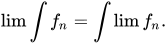
Usando-se a integral de Riemann, para se ter garantia desta propriedade é preciso exigir muito mais do que a convergência pontual: Se a sequência for uniformemente convergente, pode-se comutar o símbolo da integral com o do limite.[3]
Henri Lebesgue, em 1902 desenvolveu em sua dissertação[4] uma teoria de integração mais elegante, preenchendo as grandes lacunas na teoria de integração de Riemann. Devido a importância daquele trabalho, a teoria é hoje chamada de Integração de Lebesgue.
O conceito de mensurabilidade[editar | editar código-fonte]
Quando se estuda topologia, um conceito que está sempre presente é o de função contínua. As funções contínuas tem várias propriedades interessantes e são fundamentais no estudo de espaços topológicos. Em contrapartida, no desenvolvimento da teoria de integração, certo tipo de funções, as chamadas funções mensuráveis, também têm grande importância. Estas funções possuem algumas características em comum com as funções contínuas, e isto ficará evidente conforme forem deduzidas algumas de suas propriedades.
Ao se definir o que são funções contínuas, é levada em consideração a forma como estas funções se comportam em relação a certos subconjuntos de seu domínio e seu contradomínio. Para ser mais exato, se diz que uma função é contínua quando a pré-imagem (ou imagem inversa) de qualquer aberto do seu contradomínio é um conjunto aberto do seu domínio[5]. De forma análoga, definem-se as funções mensuráveis considerando o comportamento destas funções em relação a conjuntos abertos do contradomínio e um outro tipo de subconjuntos do seu domínio: os conjuntos mensuráveis.
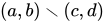
Apesar de ainda não ter sido dito o que é uma medida, esta é uma ideia que aparece em contextos bastante simples, como é o caso dos intervalos numéricos da reta de números reais. Intuitivamente, pode-se dizer que o comprimento do intervalo é igual a ou ainda, a distância de até Os intervalos são exemplos típicos de algo que se gostaria de poder "medir". Seria igualmente interessante poder medir as uniões finitas de intervalos, e também ser capaz de fornecer a medida da diferença entre dois intervalos. Propriedades como estas servem de motivação para se definir as -álgebras de conjuntos e em sequência a noção de mensurabilidade.



- Definição 1.1
Dado um conjunto diz-se que uma coleção de subconjuntos de é uma -álgebra sobre se satisfaz as seguintes condições:


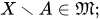
- Se então
- Se é uma sequência em então




Observações[editar | editar código-fonte]
- Obs. 1.2: Conforme já foi dito, será usada a notação para denotar o complementar de em relação a sempre que o contexto deixar claro qual o conjunto em questão. Em particular, isto se aplica ao segundo item da definição de -álgebra. Assim, a propriedade 2 diz que se pertence a uma -álgebra, então também pertence.
- Obs. 1.3: Decorre diretamente da definição que o conjunto vazio pertence a qualquer -álgebra, pois e [ver nota 1]
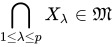
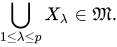
- Obs. 1.4: Utilizando as leis de De Morgan, obtém-se uma propriedade equivalente à terceira exigência da Definição 1.1, mas que envolve uma interseção enumerável:


3'. Se é uma sequência em então

- Obs. 1.5: Se é uma sequência finita em então


e
- Obs. 1.6: Se e então De fato, sendo tem-se



Como se poderia imaginar a partir dos comentários que precederam a definição definição de -álgebra, os conjuntos mensuráveis serão aqueles que verificam as propriedades acima. De forma mais precisa:
- Definição 1.7
Se é uma -álgebra sobre o par ordenado é chamado de espaço mensurável e os elementos de são denominados conjuntos mensuráveis.


- Obs. 1.8: É comum cometer um abuso de linguagem e se referir ao "espaço mensurável " sem mencionar a -álgebra como por exemplo ao dizer "o espaço mensurável ". Obviamente, isto só será feito quando ficar claro qual a -álgebra em questão. A situação análoga no contexto da Topologia é falar de um espaço topológico sem mencionar sua topologia, como em " é um espaço topológico".[ver nota 3]
Finalmente, uma vez caracterizados os conjuntos mensuráveis, a noção de mensurabilidade pode ser definida também para funções:
- Definição 1.9
Se é uma função para a qual é um espaço mensurável[ver nota 4] e é um espaço topológico[ver nota 3], diz-se que é uma função mensurável ou aplicação mensurável se para cada aberto de sua imagem inversa for um conjunto mensurável.[6]


O próximo resultado mostra uma forma de se obter funções mensuráveis quando já se conhece uma função mensurável e uma contínua: basta realizar sua composição, aplicando primeiro a função mensurável e por último a função contínua.
- Proposição 1.10
Sejam um espaço mensurável[ver nota 4], e espaços topológicos e uma aplicação mensurável. Se é uma função contínua então é uma aplicação mensurável.[7]



| Demonstração |
|---|
| Se é um aberto em então é aberto em pois é contínua. Consequentemente, é um conjuntos mensurável, pois é mensurável e é aberto. |



Um resultado análogo ao anterior, que pode ser aplicado quando se tem uma função contínua a duas variáveis reais (ou a uma variável complexa), é mostrado a seguir.
- Proposição 1.11
Sejam um espaço mensurável[ver nota 4], e espaços topológicos, onde a topologia de é a usual. Se são aplicações mensuráveis e é uma função contínua então definida por é uma aplicação mensurável.




| Demonstração |
|---|
| Considere a função definida por Então e pela proposição anterior, basta mostrar que é mensurável. Para isto, considere um aberto de Suponha inicialmente que é um retângulo cujos lados são paralelos aos eixos, ou seja, com e sendo intervalos abertos de Neste caso, tem-se
Como e são funções mensuráveis, e tanto quanto são conjuntos abertos, tem-se e mensuráveis. Mas a interseção finita de conjuntos mensuráveis é um conjuntos mensurável (ver observação anterior), então é mensurável. Se for um aberto arbitrário do espaço existe uma família enumerável de retângulos abertos em com lados paralelos aos eixos, de tal modo que Deste modo,
Uma vez que se escreve como uma união enumerável de conjuntos mensuráveis, conclui-se que ele é mensurável (conforme a terceira propriedade que define uma -álgebra). |









Como consequência imediata desta proposição, tem-se o seguinte:
- Corolário 1.12
Sejam um espaço mensurável[ver nota 4] e um espaço topológico[ver nota 3] (com sua topologia usual[8]). Se são aplicações mensuráveis, então é uma aplicação mensurável.

| Demonstração |
|---|
| Segue da proposição anterior, com e pois neste caso
para qualquer |




Um outro resultado imediato que trata especificamente da mensurabilidade de funções de uma variável complexa é o seguinte:
- Corolário 1.13
Sejam um espaço mensurável[ver nota 4] e um espaço topológico[ver nota 3] (com sua topologia usual[8]). Se é uma aplicação mensurável então são aplicações mensuráveis.


| Demonstração |
|---|
| Primeiramente, para garantir que é mensurável, basta observar que onde é dada por é uma função contínua. Então, como é a composição de uma função contínua com uma mensurável, também é mensurável.
De forma análoga, observa-se que onde é dada por também é uma função contínua. Pelo mesmo argumento segue que é mensurável. Com o mesmo raciocínio mostra-se que é mensurável, pois a função é contínua e |








Além do que já foi mostrado até o momento, no conjunto das funções mensuráveis que tomam valores em um corpo também verifica uma propriedade muito frequente em matemática: o fechamento em relação a soma e o produto. Uma consequência disto é que um polinômio em funções mensuráveis continua sendo mensurável e, em particular, a multiplicação de uma função mensurável por uma constante (ou se preferir, um escalar) também é mensurável. O resultado que garante estas propriedades é apresentado a seguir.
- Corolário 1.14
Sejam um espaço mensurável[ver nota 4], um espaço topológico[ver nota 3] (com sua topologia usual[8]) e Se são mensuráveis então e são mensuráveis.




| Demonstração |
|---|
| ;Caso 1
Se basta observar que a função de duas variáveis reais é contínua e que
portanto, é mensurável (conforme a Proposição 1.11). Do mesmo modo, tomando tem-se novamente uma função de duas variáveis que é contínua e tal que
Donde se conclui pela mesma proposição que é mensurável. Considerando a função constante definida por tem-se mensurável. De fato, seja um aberto de Então e ambos estes conjuntos são mensuráveis. Assim, considerando que
para qualquer tem-se igual ao produto de duas funções mensuráveis e, portanto, é também mensurável. Em particular, quando conclui-se que é mensurável.
Se considere e as partes reais de e respectivamente. Do mesmo modo, sejam e as partes imaginárias de e respectivamente. Isto significa que e e consequentemente e Conforme já foi demonstrado, se e forem funções mensuráveis, tem-se e mensuráveis. Pela demonstração do caso 1, as somas e são mensuráveis. Logo é mensurável. Do mesmo modo, segue do caso 1 que e são mensuráveis, portanto também é. Finalmente, a mensuralidade de no caso complexo segue da mensurabilidade do produto de funções complexas recém provada, usando o mesmo argumento do caso real. |

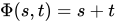






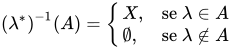








- Obs. 1.15: Seja um espaço mensurável[ver nota 4]. Então o conjunto


munido das operações pontuais de adição, multiplicação e multiplicação por escalar, é uma -álgebra (ou também uma sub -álgebra de ).

- Definição 1.16
Dado um conjunto e a função característica de é a função definida por



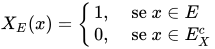
Obs. 1.17: Note que o domínio da função característica de é e não


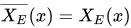
O próximo resultado mostra que um conjunto é mensurável se, e somente se, a sua função característica for mensurável (se vista como uma função que toma valores em Por simplicidade, a função definida por em cada elemento de também será denotada pelo símbolo ficando implícito que o contradomínio é o conjunto dos números reais ao se falar sobre a sua mensurabilidade. Além disso, como já foi dito, se não for feita indicação em contrário será considerada a topologia usual de



- Proposição 1.18
Dado um espaço mensurável e as seguintes afirmações são equivalentes
- é mensurável;
- é uma função mensurável;


| Demonstração |
|---|
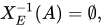
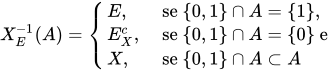
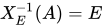
| Assuma primeiramente que é mensurável. Se é um subconjunto aberto de então ou No primeiro caso, tem-se que é mensurável[ver nota 5]. No segundo caso, tem-se:
Segue da definição de -álgebra que é mensurável e, como é mensurável (por hipótese), também resulta que é mensurável. Isto significa que é sempre mensurável quando é um aberto. Portanto, é uma função mensurável. Reciprocamente, se é uma função mensurável. Tomando o aberto igual ao intervalo tem-se [ver nota 6]. Então é mensurável pois, por hipótese, a função característica de é mensurável. |




- Proposição 1.19
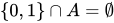
Dado um espaço mensurável e uma função mensurável existe uma função mensurável tal que para todo e


| Demonstração |
|---|
| Esta demonstração é deixada a cargo do leitor. Sinta-se livre para melhorar a qualidade deste texto, incluindo-a na versão online deste material. |
A seguir, é demonstrado um a interseção de uma família de -álgebras é ainda uma -álgebra.
- Lema 1.20
Se é um conjunto não-vazio e é uma família[ver nota 7] de -álgebras sobre então é uma -álgebra sobre



| Prova |
|---|
| Esta prova é deixada a cargo do leitor. Sinta-se livre para melhorar a qualidade deste texto, incluindo-a na versão online deste material. |
- Proposição 1.21
Se é um conjunto não-vazio e é um de seus subconjuntos, então existe a menor -álgebra sobre que contém


| Demonstração |
|---|
| Esta demonstração é deixada a cargo do leitor. Sinta-se livre para melhorar a qualidade deste texto, incluindo-a na versão online deste material. |
- Definição 1.22
A menor -álgebra sobre que contém é chamada de -álgebra gerada por e denotada por


Exercícios[editar | editar código-fonte]
- Exercício
Demonstre que se obtém uma definição de -álgebra equivalente a que foi dada se for trocada a propriedade 3 por 3', ou seja, se for exigido que a interseção enumerável de mensuráveis seja mensurável (em vez da união enumerável).
| Resolução |
|---|
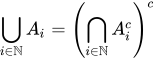
| Basta observar que, pelas leis de De Morgan, e também De fato, supondo que para cada tem-se pela propriedade 2 que para cada Então, se for assumida a propriedade 3' como parte da definição, resulta
Usando a propriedade 2 novamente tem-se De forma completamente análoga, assumindo 3' como parte da definição, segue a propriedade 3. |


- Exercício
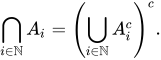
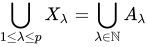
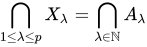
Mostre que a interseção finita e a união finita são mensuráveis sempre que os conjuntos forem mensuráveis.


| Resolução |
|---|
| Basta definir a sequência como:
Então, uma vez que é mensurável, se os conjuntos são mensuráveis, resulta que todos os termos da sequência são mensuráveis. Então, a propriedade 3 pode ser aplicada para se concluir que é mensurável. Do mesmo modo, a propriedade 3' implica que é mensurável. |

- Exercício
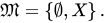
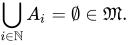
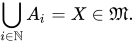
Dado um conjunto arbitrário, verifique se os seguintes conjuntos são -álgebras sobre :


| Resolução |
|---|
1. Considere Há três propriedades que devem ser verificadas por para que ele seja uma -álgebra sobre :
Portanto, é uma -álgebra. 2. Deixado a cargo do leitor. |




- Exercício
Se é um conjunto infinito, é verdade que é uma -álgebra sobre ?

| Resolução |
|---|
| A resolução deste exercício é deixada a cargo do leitor. Sinta-se livre para melhorar a qualidade deste texto, incluindo-a na versão online deste material. |
- Exercício
Seja é um conjunto arbitrário e Demonstre que é uma -álgebra sobre e que



| Resolução |
|---|
| A resolução deste exercício é deixada a cargo do leitor. Sinta-se livre para melhorar a qualidade deste texto, incluindo-a na versão online deste material. |
Notas[editar | editar código-fonte]
- ↑ Ver propriedades 1 e 2 da Definição 1.1
- ↑ Como a propriedade 2 da Definição 1.1 garante que e, pela observação anterior, a interseção desta diferença com está em
- ↑ 3,0 3,1 3,2 3,3 3,4 A rigor, um espaço topológico é um par onde é uma topologia para o conjunto Para mais detalhes, consulte um dos livros citados nas referências do wikilivro Topologia, por exemplo General topology, de John L. Kelley, página 37.
- ↑ 4,0 4,1 4,2 4,3 4,4 4,5 4,6 Note que está sendo cometido um abuso de linguagem: a rigor, um espaço mensurável é na verdade um par e não apenas um conjunto No entanto, conforme foi mencionado na Observação 1.9, é costume não explicitar a -álgebra principalmente quando esta puder ser deduzida pelo contexto.
- ↑ Na Obs. 1.3 se justifica porque o conjunto vazio é mensurável.
- ↑ Note que qualquer outro conjunto aberto com esta propriedade também serve.
- ↑ Está sendo suposto que a família é não-vazia, ou seja, que o seu conjunto de índices não é vazio.


Referências[editar | editar código-fonte]
- ↑ Conforme introdução do livro "The Elements of Integration and Lebesgue Measure", escrito por Bartle. Ver também a seção History, do artigo sobre integrais na Wikipédia inglesa.
- ↑ Ver na Wikiversidade a ementa da disciplina "Introdução ao Cálculo".
- ↑ Este teorema da análise é explicado em detalhes no capítulo sobre Convergência uniforme do wikilivro de Análise real.
- ↑ Lebesgue (1902)
- ↑ Para maiores detalhes, pode ser consultado o wikilivro intitulado "Topologia", ou alguma de suas referências.
- ↑ Alguns autores definem a mensurabilidade de funções a partir de outra propriedade (que será apresentada na Proposição 2.29). Veja, por exemplo, Isnard (2007), pág. 57.
- ↑ Isnard (2007) apresenta uma versão deste resultado, com e sendo espaços vetoriais normados, no exercício 13 da página 109.
- ↑ 8,0 8,1 8,2 Conforme K. D. Joshi em seu livro Introduction to General Topology, a topologia usual de é aquela induzida pela métrica euclidiana.
A reta real estendida
No estudo da teoria da medida, é comum lidar com sequências e séries de funções. Como se sabe da análise real, algumas vezes os termos de uma sequência assumem valores arbitrariamente grandes e este é um dos casos em que se diz que a sequência não converge. Entretanto, em certos contextos é extremamente útil considerar este tipo de sequência como sendo convergente, pois os seus termos "tendem a infinito" ou se "aproximam do infinito". O problema é que o "infinito" não faz parte do conjunto dos números reais, então para que esta noção possa ter um sentido mais preciso, costuma-se definir um novo conjunto a partir dos números reais e dos elementos e de modo que este seja uma extensão da reta real:


- Definição 2.23
A reta real estendida é o conjunto


- Obs. 2.24: Por simplicidade, também poderá ser usada a notação para o elemento de A reta real estendida também costuma ser denotada por


![{\displaystyle \left[-\infty ,\infty \right].}](https://wikimedia.org/api/rest_v1/media/math/render/svg/5e103b0b69ad9df52b2a5a5629571d19f9c32eed)
Em capítulos posteriores será considerado frequentemente o subconjunto da reta real estendida definido por

.
![{\displaystyle {\overline {\mathbb {R} }}_{+}:=\left[0,\infty \right]=\mathbb {R} _{+}\cup \{\infty \}}](https://wikimedia.org/api/rest_v1/media/math/render/svg/c79f401c3d3e12f715c3b1781a2c2320ff1e97c5)
Há outros motivos importantes para se considerar o ao longo da teoria da medida, por exemplo:
- É de interesse poder integrar funções sobre conjuntos que tenham "medida infinita": perceba que tem, intuitivamente, comprimento infinito;
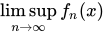
- Mesmo quando se pretende fazer a integração de funções que tomam valores reais, pode ocorrer que ao considerar uma sequência de funções o valor de ou de seja infinito em alguns pontos Em tais situações, caso não se trabalhe com o , se perde uma parte da elegância e simplicidade dos principais resultados sobre convergência (por exemplo, o teorema da convergência monótona e a "integração termo a termo" de séries de funções). Torna-se então mais conveniente a introdução do símbolo e de algumas convenções para se fazer cálculos envolvendo este símbolo.


Na próxima seção serão definidas algumas estruturas que facilitam o uso de uma relação de ordem, uma topologia e também uma aritmética.

Ordem, topologia e aritmética na reta real estendida[editar | editar código-fonte]
A retal real estendida se torna um conjunto totalmente ordenado definindo para todo número real . Analogamente, a ordem sobre é induzida ordem de ou seja, para cada se tem



Com esta ordem, se e não é limitado superiormente, isto é, se para todo existe algum tal que então Analogamente, se não é limitado inferiormente, então Deste modo, todo subconjunto não vazio de (e, em particular, de ) tem supremo e ínfimo[ver nota 1] em o que faz da reta real estendida um reticulado completo. Este é um dos principais motivos para a introdução dos símbolos e




A partir desta relação de ordem, defini-se a topologia da ordem sobre Os intervalos abertos são os subconjuntos de que podem ser escritos em uma das seguintes formas:


![{\displaystyle (a,+\infty ]:=\{x\in {\overline {\mathbb {R} }}:a\in \mathbb {R} {\text{ e }}a<x\leq +\infty \}}](https://wikimedia.org/api/rest_v1/media/math/render/svg/b184d6292b3eb77805b00c6fcf7ad6bdf7564eb9)
Deste modo, um conjunto é aberto se for uma reunião de intervalos dos tipos acima (pois eles formam uma base de abertos para ).

Com esta topologia, as noções de limite envolvendo o infinito podem ser definidas de forma unificada a partir da definição topológica de limite.
Observe que ao fazer a interseção de com intervalos abertos de se obtém um intervalo aberto de ou seja, um conjunto da forma ou Levando em conta que estes intervalos formam uma base de abertos para a topologia usual de segue que tal topologia é induzida pela que se definiu sobre anteriormente e que a inclusão é contínua. Do mesmo modo, a topologia usual sobre é a induzida pela topologia usual de



As operações aritméticas de podem ser parcialmente estendidas para da seguinte maneira[1]:
![{\displaystyle {\begin{aligned}a+\infty =+\infty +a&=+\infty ,&a&\neq -\infty \\a-\infty =-\infty +a&=-\infty ,&a&\neq +\infty \\a\cdot \pm \infty =\pm \infty \cdot a&=\pm \infty ,&a&\in (0,+\infty ]\\a\cdot \pm \infty =\pm \infty \cdot a&=\mp \infty ,&a&\in [-\infty ,0)\\a\cdot +\infty =+\infty \cdot a&=0,&a&=0\end{aligned}}}](https://wikimedia.org/api/rest_v1/media/math/render/svg/887acb3c5c97a9eea963f12d4857fee0aa76d920)
Aqui, significa tanto quanto e significa tanto quanto


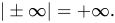
Também será convencionado que [2]
Quando se restringe as operações apenas ao conjunto vale:


![{\displaystyle a\cdot \infty =\infty \cdot a={\begin{cases}\infty ,&{\mbox{se }}a\in (0,+\infty ]\\0,&{\mbox{se }}a=0\end{cases}}}](https://wikimedia.org/api/rest_v1/media/math/render/svg/9b0dcee79895ff653a9928c5d10729acea8df58c)
Por mais estranho que possa parecer a definição de (ou ) como sendo verifica-se facilmente que, com esta escolha, em continuam valendo as propriedades comutativa, associativa e distributiva, sem qualquer restrição. Vale ressaltar, no entanto, que as "leis de cancelamento" devem ser usadas com cuidado, pois:


- apenas no caso em que
- somente quando se tem




As expressões e (chamadas de "formas indeterminadas") serão deixadas indefinidas, como é de costume em outros textos da área. As regras acima podem ser intuídas a partir das propriedades usuais de limites que tomam valores infinitos, presentes nos textos de cálculo.


Com as definições dadas, não é um corpo nem mesmo um anel. Apesar disto, ele ainda possui diversas propriedades bastante convenientes:
- e ou são iguais ou são ambos indefinidos.
- e ou são iguais ou são ambos indefinidos.
- e ou são iguais ou são ambos indefinidos.
- e ou são iguais ou são ambos indefinidos
- e são iguais se ambos estiverem definidos.
- Se e se tanto quanto estiverem definidos, então .
- Se e e tanto quanto estiverem definidos, então .









Em geral, todas as regras usuais de aritmética continuam válidas em desde que todas as expressões envolvidas estejam definidas.
Na próxima seção será considerado uma -álgebra que pode ser definida de modo muito natural a partir da topologia de um conjunto: Se é um espaço topológico, tem-se em particular que Neste caso, conforme se demonstrou na Proposição 1.21 existe a menor -álgebra sobre que contém que é Isto motiva a próxima definição.


Conjuntos de Borel[editar | editar código-fonte]
- Definição 2.25
Seja um espaço topológico. A -álgebra gerada pela topologia é denominada -álgebra de Borel. Qualquer elemento desta -álgebra é chamado de conjunto de Borel de ou boreliano de [3]


- Obs. 2.26: Quando a topologia estiver subentendida, será dito simplesmente "conjunto de Borel de " ou "boreliano de ". Se não houver risco de confusão, pode-se denotar a -álgebra simplesmente por
- Obs. 2.27: Considerando que os abertos da topologia são mensuráveis, os seus complementares são também mensuráveis pela propriedade 2 da definição de -álgebra. Consequentemente, as reuniões eumeráveis de conjuntos fechados também são mensuráveis, conforme a propriedade 3 da mesma definição. Além disso, da observação 1.4 segue que as interseções enumeraveis de abertos também são elementos da -álgebra de Borel.


Conforme se aprende em topologia, se e são espaços topológicos, e é uma função contínua, então a pré-imagem de qualquer aberto é um aberto da topologia Neste caso, levando em conta que se conclui que para qualquer Isto significa que é mensurável em relação a e Estas funções mensuráveis recebem os nomes específicos, conforme a próxima definição.


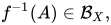


- Definição 2.28
Sejam e espaços topológicos. Uma função Borel mensurável é qualquer função contínua Se tais funções são denominadas funções de Borel ou ainda aplicações de Borel.


- Proposição 2.29
Seja um espaço mensurável. Se é um espaço topológico e é uma função entre estes espaços, então:


- é uma -álgebra sobre
- Se é mensurável (em relação a e ) então e para qualquer que seja
- Se e para todo então é mensurável.



![{\displaystyle f^{-1}((a,\infty ])\in {\mathfrak {M}}}](https://wikimedia.org/api/rest_v1/media/math/render/svg/08f1c9c396d1134712db7af4efd3134997a9434b)

| Demonstração |
|---|
| Esta demonstração é deixada a cargo do leitor. Sinta-se livre para melhorar a qualidade deste texto, incluindo-a na versão online deste material. |
A última propriedade da proposição anterior costuma ser usada para verificar se determinada função que toma valores reais é ou não mensurável[4].
A próxima definição apresenta alguns conceitos relacionados a ideia de limite: os limites de oscilação. Sua importância será notada no decorrer do estudo de sequências, tanto numéricas quanto de funções.
- Definição 2.30
Seja uma sequência em o limite inferior de é o elemento de dado por





| Demonstração |
|---|
| Esta demonstração é deixada a cargo do leitor. Sinta-se livre para melhorar a qualidade deste texto, incluindo-a na versão online deste material. |
A seguir serão definidas algumas operações que se costuma fazer com funções com imagem na reta real estendida. A essência de tais operações é "tomar um limite em cada ponto do domínio da função". A definição 2.31 formaliza esta ideia:
- Definição 2.33
Seja uma sequência de funções definidas em um subconjunto de Definem-se as funções e de em através das fórmulas:






Além disso, se em cada existe define-se o limite pontual da sequência no ponto como sendo:



- Proposição 2.39
Seja um espaço mensurável e considere para cada uma função Se é mensurável, para todo então as funções e são mensuráveis.[5]


| Demonstração |
|---|
| Esta demonstração é deixada a cargo do leitor. Sinta-se livre para melhorar a qualidade deste texto, incluindo-a na versão online deste material. |
- Corolário 2.40
Seja um espaço mensurável e considere para cada uma função mensurável Se converge pontualmente para então é mensurável.[6]


| Demonstração |
|---|
| Esta demonstração é deixada a cargo do leitor. Sinta-se livre para melhorar a qualidade deste texto, incluindo-a na versão online deste material. |
- Corolário 2.41
Seja um espaço mensurável. Se e são mensuráveis então as funções e são mensuráveis.[7]


| Demonstração |
|---|
| Esta demonstração é deixada a cargo do leitor. Sinta-se livre para melhorar a qualidade deste texto, incluindo-a na versão online deste material. |
No desenvolvimento da teoria de integração, será importante considerar os seguintes tipos particulares de funções da forma e

- Definição 2.42
Seja um conjunto, uma função e a função nula. A parte positiva de é a função definida por


Analogamente a parte negativa de é a função definida por

- Lema 2.45
Seja um conjunto, uma função e a função nula. Então:
- Se é um espaço mensurável e é mensurável, então e são mensuráveis;[8][ver nota 2]
- Se é um espaço mensurável e tanto quanto são mensuráveis, então e são mensuráveis;
- Se com e então e


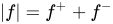
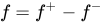


| Demonstração |
|---|
| Esta demonstração é deixada a cargo do leitor. Sinta-se livre para melhorar a qualidade deste texto, incluindo-a na versão online deste material. |
Obs. 2.46: O último item do Lema 2.45 pode ser interpretado da seguinte maneira: e são as menores funções não-negativas cuja diferença é Neste sentido, pode-se dizer que a representação é mínima.

Notas[editar | editar código-fonte]
- ↑ Lembre-se que em só os conjuntos limitados possuem esta propriedade
- ↑ Note que aqui é usada a convenção
Referências[editar | editar código-fonte]
- ↑ Ver também: Isnard (2007), pág. 60.
- ↑ Conforme Isnard (2007), pág. 61, Corolário 5.7.
- ↑ Ver também Isnard (2007), pág. 116.
- ↑ Compare a Definição 1.9 com a definição de Isnard (2007), pág. 57.
- ↑ No livro de Isnard (2007), este teorema corresponde às proposições 5.6 (pág. 61) e 5.10 (i) (pág. 63).
- ↑ No livro de Isnard (2007), este corolário corresponde ao item (ii) da proposição 5.10 (pág. 63).
- ↑ No livro de Isnard (2007), este corolário aparece como caso particular do item (ii) na proposição 5.6 (pág. 61).
- ↑ No livro de Isnard (2007), este item corresponde ao corolário 5.7 (pág. 61).
Funções simples e a topologia da reta estendida
Em linhas gerais, uma função simples é uma função que assume uma quantidade finita de valores. No contexto da teoria abordada neste livro, a definição de função simples incluirá algumas restrições adicionais, de modo que este nome possa ser usado apenas para se referir ao tipo de específico de função simples que é relevante para a integração.
- Definição 3.1
Seja um espaço mensurável. Uma função simples sobre é qualquer função tal que é um conjunto finito.


Exemplo[editar | editar código-fonte]
A função definida por é uma função simples. De fato, tem-se
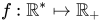

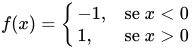
Isto significa que que é finito. Observe ainda que


Em geral, se e se definem os conjuntos para cada de a resulta que Note que é uma partição finita de

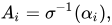


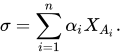

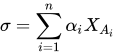
Por outro lado, sempre que se tem uma partição finita de e uma sequência finita de elementos em de modo que quando a equação define uma função simples. É comum se referir ao segundo membro daquela equação como sendo a representação canônica de



- Lema 3.2
Seja um espaço mensurável e a função simples sobre dada por
Então para que seja mensurável é necessário e suficiente que cada seja mensurável, onde

| Demonstração |
|---|
| Nesta demonstração, quando será usada a notação para indicar o conjunto .
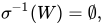
Primeiramente, supondo que seja mensurável e observando que cada conjunto é aberto em tem-se mensurável. Mas então cada um dos conjuntos é mensurável. Como o complementar de um conjunto mensurável é mensurável, tem-se mensurável para todo Reciprocamente, assumindo que é mensurável quando e tomando um aberto de deve-se mostrar que é mensurável. Há dois casos que precisam ser considerados: A primeira situação só pode ocorrer se que é um conjunto mensurável. No segundo caso, o conjunto é não vazio e é possível escrever Sendo esta uma união finita de conjuntos mensuráveis, conclui-se que é mensurável. Portanto a função também é mensurável.
|









- Teorema 3.4
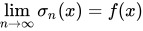
Seja um espaço mensurável. Se e é a função nula, então existe uma sequência de funções simples, mensuráveis em de modo que:


- para todo
- em todo ponto


| Demonstração |
|---|
| Para cada pode-se particionar o intervalo em intervalos iguais da seguinte forma:
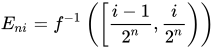
Considere a pré-imagem por de cada um destes intervalos:
e defina também
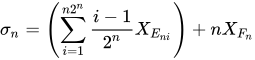
A seguir, será demonstrado que a sequência de funções cujos termos são dados por
satisfaz as condições estipuladas no enunciado do teorema. Isto será feito em três etapas:
Primeiramente, fixe um ponto e um inteiro positivo Para mostrar que observe que:
Como há duas possibilidades:
Na primeira delas, tem-se e portanto Mas
então deve estar em um destes dois intervalos disjuntos, isto é, ou Se ocorrer então Por outro lado, caso ocorra então Portanto, Na segunda possibilidade, tem-se e consequentemente Além disso,
então deve estar em um destes dois intervalos disjuntos. No caso em que isto é, se deduz que A outra alternativa é que e de se conclui que
Usando isto em conjunto com a desigualdade se deduz que existe algum índice tal que e Isto implica que pela própria definição deste conjunto. Logo, Com isto, se conclui a prova de que a sequência é não-decrescente. Agora, para garantir que basta observar que se e então
Finalmente, em todo ponto De fato, para cada pode ocorrer ou
|








![{\displaystyle {\overline {\mathbb {R} }}_{+}=\left(\cup _{i=1}^{n2^{n}}\left[{\frac {i-1}{2^{n}}},{\frac {i}{2^{n}}}\right)\right)\cup \left[n,\infty \right].}](https://wikimedia.org/api/rest_v1/media/math/render/svg/6e249dc9e8b45d58018305934fe70b8389c72c08)

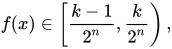

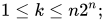
![{\displaystyle f(x)\in \left[n,\infty \right]}](https://wikimedia.org/api/rest_v1/media/math/render/svg/6192df7d561aff281c044470debf1c9dd95baec8)

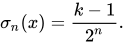


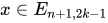

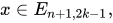











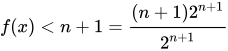
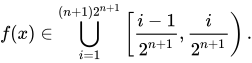
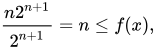
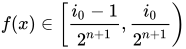




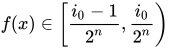

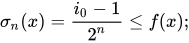






![{\displaystyle f(x)\not \in \left[n,+\infty \right]}](https://wikimedia.org/api/rest_v1/media/math/render/svg/206777d43fd259fa15732ae03e29124df8f5e150)

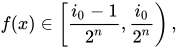


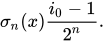

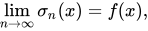

Obs. 3.5: No caso em que é uma função limitada, ou seja, quando existe uma constante para a qual em todo ponto pode-se tomar na prova acima. Nesta situação, a conclusão é que a sequência converge uniformemente para


Com relação as sequências cujos termos estão em tem-se a seguinte propriedade: Se e são sequências não decrescentes em ou seja, e para todo e existem os limites e então





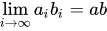
Esta propriedade, juntamente com a Proposição 2.39 e o Teorema 3.4, implicam que se
- Proposição 3.6
Se e são funções mensuráveis, então e também são mensuráveis.

| Demonstração |
|---|
| Esta demonstração é deixada a cargo do leitor. Sinta-se livre para melhorar a qualidade deste texto, incluindo-a na versão online deste material. |
Notas[editar | editar código-fonte]
Referências[editar | editar código-fonte]
Medida
- Definição 4.1
- Seja uma -álgebra sobre um conjunto Uma medida positiva sobre é uma função satisfazendo a seguinte propriedade:
- Dada uma sequência de elementos de cujos termos são dois a dois disjuntos, vale
- Existe algum conjunto para o qual
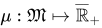
- Um espaço com medida ou espaço de medida[1] é uma terna ordenada em que é uma -álgebra sobre o conjunto (ou seja, é um espaço mensurável) e é uma medida positiva sobre
- Uma medida complexa limitada é uma função para a qual para toda sequência disjunta de elementos de




- Obs. 4.2: Apesar de serem chamadas de "positivas" as medidas abordadas neste capítulo tomam valores "não negativos". Neste sentido, talvez fosse preferível a terminologia "medida não negativa", em vez da adotada neste texto. No entanto, o uso da expressão mais simples não deve gerar confusão.
- Obs. 4.3: A exigência de que algum elemento da -álgebra tenha medida finita é apenas para evitar trivialidades, como a "medida" que toma o valor infinito em todos os elementos de
- Obs. 4.4: Uma vez que este capítulo irá abordar essencialmente as medidas positivas, elas serão chamadas simplesmente de "medidas" quando isto não causar confusão.
- Proposição 4.5
Se é uma medida positiva sobre uma -álgebra então:
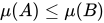
- Se é uma sequência disjunta finita cujos termos estão em então
- Se e estão em e então e Se, além disso, então
- Se é uma sequência cujos termos estão em e verificam para todo então
- Se é uma sequência cujos termos estão em e verificam para todo e então











| Demonstração |
|---|
| Esta demonstração é deixada a cargo do leitor. Sinta-se livre para melhorar a qualidade deste texto, incluindo-a na versão online deste material. |
- Obs. 4.6: Com exceção do terceiro item desta proposição, as demais propriedades continuam valendo no caso das medidas complexas finitas, pois a prova é idêntica.
Antes de passar aos exemplos mais interessantes de medidas, pode-se apresentar alguns tipos bem simples, conforme os próximos exemplos mostram. A medida de Lebesgue sobre possui uma construção mais elaborada, e por isso será introduzida em um capítulo posterior.

Exemplos[editar | editar código-fonte]
- Medida da contagem
- Dado um conjunto arbitrário pode-se definir uma medida da seguinte maneira:
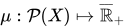

A verificação de que esta função é realmente uma medida fica a cargo do leitor. Sinta-se convidado a melhorar a qualidade deste texto, incluindo-a neste módulo.
- Medida de Dirac em
- Dado um conjunto arbitrário e um ponto qualquer define-se como


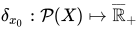
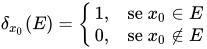
A verificação de que esta função é realmente uma medida fica a cargo do leitor. Sinta-se convidado a melhorar a qualidade deste texto, incluindo-a neste módulo.
Esta medida também é conhecida popularmente pelo nome de "medida da massa unitária concentrada em ".
- Generalização
- Os exemplos anteriores são casos particulares de um tipo mais geral de medida. Para perceber isto, é preciso considerar um tipo de "soma" que envolve famílias não enumeráveis de números reais não negativos. Considere um conjunto e uma função Defina
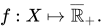

Posteriormente será visto que esta soma é a "integral de " em relação a medida da contagem sobre Agora que foi estabelecida uma notação para este tipo de soma, observe que a função determina uma medida positiva sobre a -álgebra da seguinte maneira:
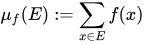
Com as notações anteriores, tem-se a medida da contagem sobre quando é a função constante igual a

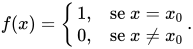
Analogamente, a medida de Dirac em é obtida quando existe algum tal que

- Contra-exemplo
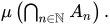
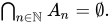
- No último item da Proposição 4.5, é realmente necessário que se verifique a hipótese caso contrário não se tem garantia sobre qualquer relação entre e Por exemplo, se é a medida da contagem sobre e se define para cada o conjunto então obviamente para todo e No entanto, para todo e, em particular, Neste caso,







Sobre a as notações e a terminologia[editar | editar código-fonte]
Na definição Definição 4.1, caracterizou-se um "espaço de medida" como sendo uma terna ordenada em que é um conjunto, é uma -álgebra sobre e é uma medida positiva sobre Analogamente, na definição de "espaço mensurável", é explicitado um par ordenado no qual é um conjunto e é uma -álgebra sobre A presença de todo este formalismo é geralmente vantajosa, e por vezes necessária, principalmente ao se definir os novos conceitos. No entanto, tal formalismo é de certo modo dispensável: Ao definir um espaço de medida é considerada a função Como toda função tem um domínio, e no caso de o domínio é uma -álgebra, basta conhecer a medida para saber quem é Além disso, sabendo-se quem é se deduz qual é o conjunto pois ele é simplesmente o maior conjunto que pertence a qualquer -álgebra sobre


Sendo assim, é aceitável usar expressões informais como, por exemplo, "seja uma medida". No caso de ser necessário dar alguma ênfase para a -álgebra ou para o conjunto poderia ser dito "seja uma medida sobre " ou "seja uma medida sobre X".
Em síntese, é de uso corrente nos livros da área expressões e notações simples, em vez de suas formulações "logicamente impecáveis", então o leitor não deve se espantar ao se deparar com frases do tipo "seja um espaço com medida", já que em tais situações ficará implícito que há alguma medida definida sobre alguma -álgebra sobre conforme as observações anteriores sugerem.
Ver também[editar | editar código-fonte]
- Counting measure: Artigo sobre a medida da contagem, na Wikipédia inglesa;
- Dirac measure: Artigo sobre a medida de Dirac, na Wikipédia inglesa;
Notas[editar | editar código-fonte]
Integração de funções positivas
Ao longo deste capítulo estará fixado um espaço com medida

- Definição 5.1
Considere uma função simples mensurável sobre , cuja forma canônica é dada por:

ou seja,
- tem elementos[ver nota 1];
- é uma partição de ; e
- Para cada tem-se



Nestas condições, define-se para cada a integral de sobre em relação à medida como sendo:


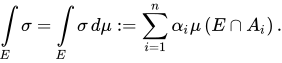
- Obs. 5.2: Note como está sendo usada a convenção de que pode acontecer de existir algum índice para o qual e . A convenção foi feita de tal modo que ao colocar um coeficiente nulo em uma parcela, a medida do subconjunto de correspondente não interfira no valor final da integral.
- Obs. 5.3: Pode ser demonstrado que o fato da função simples estar ou não expressa em sua forma canônica não influi no valor produzido pela fórmula 5.1.1.


- Exercício
- Justifique a afirmação feita na Observação 5.3.
| Resolução |
|---|
| A resolução deste exercício é deixada a cargo do leitor. Sinta-se livre para melhorar a qualidade deste texto, incluindo-a na versão online deste material. |
Pelo Teorema 3.4, toda função pode ser aproximada por uma sequência não-decrescente de funções simples. Isto motiva a próxima definição, na qual é apresentada a noção de integral para um certo tipo de funções que não são simples.
- Definição 5.4
Se é uma função mensurável, define-se para cada a integral de Lebesgue de sobre em relação à medida como sendo o elemento de dado por:

![{\displaystyle {\overline {\mathbb {R} }}_{+}=[0,\infty ]}](https://wikimedia.org/api/rest_v1/media/math/render/svg/55a901f47e1cd7cd6e77fa2a7eca62e593368c57)
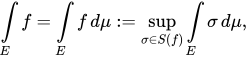
onde é função simples, mensurável sobre e tal que [ver nota 2]
No caso em que se diz que é integrável em . Se então se diz simplesmente que é integrável.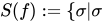


- Obs. 5.5: Note que se uma função mensurável é simples, a fórmula 5.4.1 da Definição 5.4 fornece para a integral uma expressão que, a primeira vista, não tem motivo para coincidir com aquela da fórmula 5.1.1 presente na Definição 5.1. No entanto, pode-se verificar que elas de fato fornecem o mesmo valor.

- Exercício
- Justifique a afirmação feita na Observação 5.5.
| Resolução |
|---|
| A resolução deste exercício é deixada a cargo do leitor. Sinta-se livre para melhorar a qualidade deste texto, incluindo-a na versão online deste material. |
- Lema 5.6
Dado um espaço com medida e uma partição finita de em conjuntos mensuráveis, considere a função simples mensurável[ver nota 3] definida por


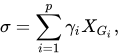
onde, para cada tem-se Então, para todo vale:



| Demonstração |
|---|
| Esta demonstração é deixada a cargo do leitor. Sinta-se livre para melhorar a qualidade deste texto, incluindo-a na versão online deste material. |
- Lema 5.7
Dado um espaço com medida e as funções simples mensuráveis e Se [ver nota 4], então para qualquer tem-se:


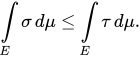
| Demonstração |
|---|
| Esta demonstração é deixada a cargo do leitor. Sinta-se livre para melhorar a qualidade deste texto, incluindo-a na versão online deste material. |
- Obs. 5.8: Se é mensurável, então a função que em cada valor é definida por também é mensurável. Deste modo, a Definição 5.4, que se aplica a função pode também ser aplicada à função

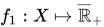
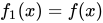

- Proposição 5.9
Seja uma função mensurável. A integral definida anteriormente verifica as seguintes propriedades:
- Se é mensurável e então
- Se e então
- Se então
- Se para todo vale então [ver nota 5]
- Se então [ver nota 6]

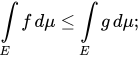


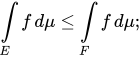

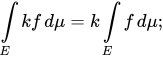


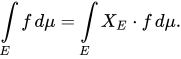
| Demonstração |
|---|
| Esta demonstração é deixada a cargo do leitor. Sinta-se livre para melhorar a qualidade deste texto, incluindo-a na versão online deste material. |

|
Este módulo tem a seguinte tarefa pendente: Explicitar no enunciado da proposição anterior as hipóteses que devem ser feitas sobre as funções envolvidas. |
- Obs. 5.10: O último item desta proposição indica que mesmo se a integral tivesse sido definida apenas sobre o conjunto ainda seria possível definir o valor da integral sobre subconjuntos mensuráveis de usando como definição a fórmula
- Obs. 5.11: É interessante notar que se então é possível definir um espaço com medida sobre de forma muito natural: A coleção de partes de definida por é uma -álgebra sobre (isto fica como exercício para o leitor). Então a função é uma medida positiva sobre e, consequentemente, é um espaço com medida. Este fato serve para reforçar a ideia central da observação anterior: se é definida a integral sobre os espaços de medida, então é definida automaticamente a integral sobre cada parte mensurável de tais espaços.
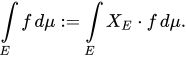




- Corolário 5.12
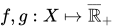
Se é um conjunto mensurável, então:
- Para quaisquer funções mensuráveis tais que tem-se

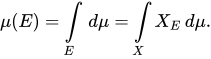
| Demonstração |
|---|
| Esta demonstração é deixada a cargo do leitor. Sinta-se livre para melhorar a qualidade deste texto, incluindo-a na versão online deste material. |
- Obs. 5.13: Note que, ao contrário do que acontecia no item correspondente da Proposição 5.9, o primeiro item deste corolário exige apenas que a desigualdade seja válida nos pontos que pertemcem a
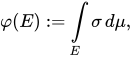
A essência do segundo item deste corolário é que a integral também serve para "medir conjuntos". Na verdade, isto continua válido mesmo que a função que está sendo integrada não seja Conforme a próxima proposição, a integração de uma função simples sobre conjuntos que pertencem a uma -álgebra define uma medida.

- Proposição 5.14
Dada uma função simples mensurável sobre , se é a função que em cada vale
então é uma medida sobre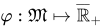

| Demonstração |
|---|
| Esta demonstração é deixada a cargo do leitor. Sinta-se livre para melhorar a qualidade deste texto, incluindo-a na versão online deste material. |
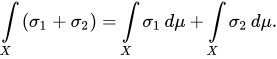
Outra propriedade que se poderia esperar da integração de funções simples é a somatividade:
- Proposição 5.15
Se e são funções simples mensuráveis sobre então:


| Demonstração |
|---|
| Esta demonstração é deixada a cargo do leitor. Sinta-se livre para melhorar a qualidade deste texto, incluindo-a na versão online deste material. |
- Lema 5.16
Se a é uma função mensurável e é uma função simples mensurável, então a função é mensurável.

| Demonstração |
|---|
| Esta demonstração é deixada a cargo do leitor. Sinta-se livre para melhorar a qualidade deste texto, incluindo-a na versão online deste material. |
- Obs. 5.17: Note que
- Obs. 5.18: O Corolário 1.14 e a observação 1.15 somente garantiam a validade deste resultado quando as imagens das funções envolvidas estavam contidas em É graças a este Lema 5.16 que será possível usar o mesmo resultado também quando a função assume o valor infinito. No entanto a demonstração é apenas uma adapatação daquela apresentada para a Proposição 1.11.


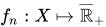
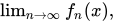
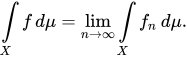
O próximo resultado é conhecido como Teorema da Convergência Monótona de Lebesgue e, além de ser um resultado importante sobre convergência, é um dos teoremas centrais de toda a teoria de Lebesgue.
- Teorema 5.19
Seja um espaço com medida e, para cada seja uma função mensurável. Se a sequência é não decrescente[ver nota 8] e, para cada existe o limite então:

- A função definida por é mensurável;

| Demonstração |
|---|
| Esta demonstração é deixada a cargo do leitor. Sinta-se livre para melhorar a qualidade deste texto, incluindo-a na versão online deste material. |
- Obs. 5.20: Note que no segundo item deste teorema, ambos os membros podem ser iguais a infinito.
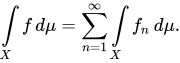
Um resultado análogo sobre a integração de séries é apresentado no teorema seguir.
- Teorema 5.21
Seja um espaço com medida e, para cada seja uma função mensurável. Então:
- A função definida por é mensurável;

| Demonstração |
|---|
| Esta demonstração é deixada a cargo do leitor. Sinta-se livre para melhorar a qualidade deste texto, incluindo-a na versão online deste material. |
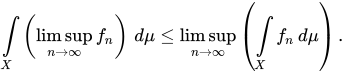
O resultado técnico apresentado a seguir, conhecido como Lema de Fatou, se mostrará extremamente importante e útil.
| Demonstração |
|---|
| Esta demonstração é deixada a cargo do leitor. Sinta-se livre para melhorar a qualidade deste texto, incluindo-a na versão online deste material. |
O próximo resultado é uma generalização da Proposição 5.14.
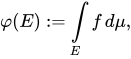
- Teorema 5.23
Seja um espaço com medida e uma função mensurável sobre Se é a função que em cada vale
então:
- é uma medida sobre ;
- Para cada função mensurável vale

| Demonstração |
|---|
| Esta demonstração é deixada a cargo do leitor. Sinta-se livre para melhorar a qualidade deste texto, incluindo-a na versão online deste material. |
- Obs. 5.24: Alguns autores indicam o segundo item deste teorema com a notação embora isto não queira dizer que os símbolos e façam sentido individualmente. A igualdade significa apenas que vale a fórmula 5.23.2 do Teorema 5.23.


Notas[editar | editar código-fonte]
- ↑ Isto é, quando
- ↑ Lembre-se que significa para todo
- ↑ A mensurabilidade desta função segue do Lema 3.2, considerando que cada é mensurável.
- ↑ Ou seja, para todo
- ↑ Mesmo quando uma vez que se convencionou que
- ↑ Mesmo quando em cada vale
- ↑ Lembre-se que é um espaço com medida.
- ↑ Isto é, se para todo e para todo


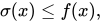

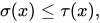



Referências[editar | editar código-fonte]
Integração de funções mais gerais
Assim como no capítulo anterior, ao longo deste capítulo será suposto fixado um espaço com medida
- Definição 6.1
Dado um espaço com medida uma função mensurável e um conjunto mensurável a integral de sobre é definida como sendo o elemento de dado por
![{\displaystyle f:X\mapsto {\overline {\mathbb {R} }}=\left[-\infty ,+\infty \right]}](https://wikimedia.org/api/rest_v1/media/math/render/svg/d35dab33849c9468799721f99da689067529f325)

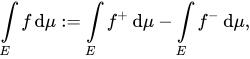
- Obs. 6.2: Toda função que toma valores reais e é mensurável continua mensurável se for vista como uma função que toma valores na reta extendia, isto é, se é uma função mensurável, então a função definida por em cada também é mensurável. Consequentemente, a Definição 6.1 também é aplicável às funções mensuráveis.


| Justificativa |
|---|
| Fica a cargo do leitor justificar este fato. Sinta-se livre para melhorar a qualidade deste texto, incluindo a justificativa na versão online deste material. |
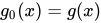
Reciprocamente, dada qualquer função mensurável para a qual a sua restrição definida por em cada também é uma função mensurável.


| Justificativa |
|---|
| Fica a cargo do leitor justificar este fato. Sinta-se livre para melhorar a qualidade deste texto, incluindo a justificativa na versão online deste material. |
- Definição 6.3
Dado um espaço com medida define-se o espaço das funções integráveis sobre em relação à medida [1] como sendo

O conjunto costuma ser simbolizado por notações mais simples como, por exemplo, ou mesmo Nestes casos, os itens que forem omitidos deverão estar claros pelo contexto. Alguns autores preferem usar , colocando o índice como sobrescrito[2].



- Definição 6.4
Para cada par de funções mensuráveis e define-se a integral da função complexa em cada como sendo:




O leitor deve observar que as funções e que aparecem na Definição 6.4 são mensuráveis, reais e não-negativas. Deste modo, existem as integrais correspondentes sobre o conjunto (ver Definição 5.4). Note também que e também de modo que, pelos itens 1 e 2 da Proposição 5.9, as integrais destas funções são finitas e, consequentemente, conforme a Definição 6.1,




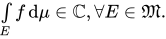
- Obs. 6.5: Se então qualquer que seja , o valor da integral de em é real, isto é:


| Justificativa |
|---|
| Fica a cargo do leitor justificar este fato. Sinta-se livre para melhorar a qualidade deste texto, incluindo a justificativa na versão online deste material. |
O teorema a seguir mostra que é um espaço vetorial seminormado (ver exercício).

- Teorema 6.6
Se e e e então



- é um espaço vetorial e a função , que associa com é uma seminorma sobre




Notas[editar | editar código-fonte]
Referências[editar | editar código-fonte]
- ↑ O espaço é um exemplo particular dos espaços (formados pelas funções cuja -ésima potência é integrável) que serão definidos mais adiante. Veja por exemplo, Rana (2002), Definição 8.4.1, p. 261.
- ↑ Ver, por exemplo, de Barra (2008), p. 109, seção 6.1.


Conjuntos de medida nula
Assim como nos capítulos anteriores, ao longo deste capítulo será suposto fixado um espaço com medida
- Definição 7.1
Dado um espaço com medida e um subconjunto mensurável diz-se que é um conjunto de medida nula quando


- Definição
Considere um espaço com medida e uma propriedade que os pontos de podem verificar ou não. Se é um conjunto mensurável, diz-se que vale quase sempre em ou que vale em quase todo ponto de quando existe um conjunto contido em tal que e que vale em


A noção que acaba de ser definida será usada com grande frequência e por isso será abreviada como vale q.s. em ou como vale em q.t.p. de .
Observe que o conceito depende fortemente da medida então quando for preciso evitar ambiguidades, ela será indicada explicitamente, como por exemplo em vale q.s. em .
![{\displaystyle [\mu ]}](https://wikimedia.org/api/rest_v1/media/math/render/svg/4b3664ec6fbfb317a0b8da2c669cc9e0d456982e)
A seguir serão apresentados vários exemplos de "propriedades que valem quase sempre" em diferentes contextos, de modo que o leitor possa se familializar com este novo conceito. Por simplicidade, será usado sempre para denotar indistintamente qualquer dos conjuntos e
- Exemplo
Diz-se que está definida q.s. em quando existe um conjunto mensurável tal que e que Neste caso, a notação não significa que é o domínio de mas apenas que Aqui, a afirmação de que " está no domínio de " corresponde à propriedade da definição anterior.





- Exemplo
Se são funções definidas q.s. em diz-se que é igual a q.s. em se existir um conjunto mensurável tal que e que Quando este é o caso, utiliza-se a notação " q.s." ou "". A a propriedade corresponde à afirmação de que "". Note que por serem funções definidas q.s. em existem conjuntos mensuráveis e de medida nula tais que para Deste modo, pode-se trocar a exigência de que por De fato, quando tem-se




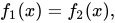



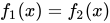









Mais adiante (na Definição ???), será dado o significado da mensurabilidade de funções que estejam definidas q.s. em Então, se for suposto que as funções do exemplo anterior forem mensuráveis, e que as imagens de ambas estão contidas em é possível comprovar que o conjunto pode ser trocado por De fato, como este conjunto é mensurável, pois é um aberto e é mensurável. Assim, tem-se que é igual a q.s. em se, e somente se,







- Exemplo
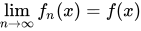
Se é uma sequência de funções tal que cada está definida q.s. em diz-se que a sequência converge (ou tende) q.s. para a função (também definida q.s. em ) caso exista um conjunto mensurável tal que e que em Se este for o caso, utiliza-se uma das seguintes notações: q.s. ou


![{\displaystyle [\mu ],}](https://wikimedia.org/api/rest_v1/media/math/render/svg/e0d9aad77770d10d68c932fcd41f0d13642ea03e)


- Exemplo
Diz-se que é finita q.s. em se existe um conjunto mensurável tal que e que


Ao longo dos próximos parágrafos serão apresentados resultados e definições com o objetivo de definir a "mensurabilidade" e a "integral" de "funções definidas quase sempre", isto é, de dizer o que significam coisas como:
- A frase " está definida q.s. em e é mensurável";
- A integral "", no caso de ser uma função do tipo acima.


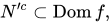
Lembrando que está definida q.s. em quando existe algum conjunto mensurável (não necessariamente único), tal que e que poderia ser feita uma tentativa de definir a mensurabilidade dizendo que tal função é mensurável se sua restrição for mensurável. No entanto, como o conjunto não tem motivo para ser único, se for outro conjunto mensurável, para o qual e este conceito de mensurabilidade só estaria bem definido se fosse independente da escolha de isto é, se fosse mensurável exatamente quando fosse mensurável. O leitor pode imaginar a dificuldade que resultaria de seguir esta direção, observando que não há uma relação simples entre os conjuntos e







Uma alternativa mais simples consiste em investigar as propriedades e consequências da seguinte definição provisória para o conceito de mensurabilidade:
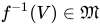
- Definição
Uma função definida q.s. em é mensurável em se para cada aberto de


Para evitar que seja feita confusão, nos próximos parágrafos será usada a expressão "mensurável no sentido usual" para indicar que uma função é mensurável de acordo com a Definição ???.
O lema a seguir mostra como construir, por exemplo, uma função mensurável no sentido usual quando já se conhece uma função definida q.s. que seja mensurável em (no sentido da definição anterior).
- Lema
Seja definida q.s. em uma função mensurável em X. Se e então a função definida por



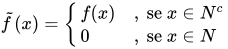
Observe que o domínio da função é todo o conjunto Além disso, por definição, existe um conjunto com as propriedades indicadas no enunciado e a função construída varia conforme a escolha deste conjunto Uma função construída como no lema anterior será chamada de redefinição de . Com essa nomenclatura, o lema anterior expressa o fato de que toda redefinição de uma função mensurável em é também mensurável no sentido usual.


Uma forma alternativa de se construir uma redefinição de uma função dada é estendê-la a todo atribuindo valores arbitrários aos pontos do conjunto de medida nula e então definir multiplicando pela função característica de (que irá zerar nos pontos de ):

É comum alguns autores (citação???) usarem a expressão anterior para definir uma redefinição de sem antes atribuir valores arbitrários para os pontos de Para isso, é convencionado (apenas por questões de praticidade) que "o produto de zero por algo que não existe dá zero".
Fazendo uso do lema anterior, é possível reformular a definição provisória do conceito de mensurabilidade (de funções definidas quase sempre). A forma mais geral do conceito é como segue:
- Definição
Uma função definida q.s. em é mensurável em quando toda redefinição de for mensurável no sentido usual.
- Lema
Seja uma sequência de funções tal que cada está definida q.s. em Se a sequência converge q.s. para a função e cada é mensurável então é mensurável (sempre no sentido da definição anterior).

Obs.: Neste ponto é razoável acrescentar uma nota sobre a coerência entre as duas definições de mensurabilidade de funções que foram apresentadas até o momento. Se uma função tem como domínio, pode-se dizer que a mesma está definida quase sempre em pois

Sendo assim, em uma primeira análise, vê-se que existem dois sentidos nos quais a função pode ser ou não mensurável:
- No sentido usual, dado pela Definição ???; ou
- Conforme a Definição ??? que acaba de ser apresentada.
Felizmente, os dois conceitos coincidem. De fato, se uma função é mensurável conforme a Definição ???, então a redefinição é mensurável no sentido usual, e consequentemente também é mensurável, pois implica que Reciprocamente, se é mensurável no sentido usual, então também é mensurável em (definição ???). Logo, aplicando o Lema ??? conclui-se que qualquer redefinição de é mensurável, isto é, é mensurável de acordo com a Definição ???.


Obs.: Pode-se estender as definições e resultados anteriores para o caso de funções (em vez de ), em que bastando trocar por conforme foi feito em ???. Assim, fixando-se um espaço com medida um conjunto mensurável e uma função definida q.s. chama-se de redefinição de a qualquer função definida como

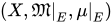

onde é um subconjunto de de medida é nula, tal que A função diz-se mensuravel se cada uma de suas redefinições for mensurável no sentido usual (o que faz sentido já que ).


Para dar continuidade ao que foi iniciado logo depois do exemplo ???, o próximo passo é dar sentido à notação no caso de ser uma função mensurável definida q.s. em Antes disso, porém, será introduzida uma notação adicional e serão deduzidos alguns resultados preliminares bastante simples.
Conforme o exemplo ???, q.s. significa existir um conjunto mensurável tal que e que O leitor pode verificar que a relação de "ser igual quase sempre em um conjunto em relação a uma certa medida" é, na verdade, uma relação de equivalência sobre o conjunto

Isto justifica o uso de notações adicionais como ou (ou simplesmente ) quando as funções e forem iguais quase sempre em


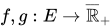
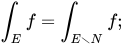
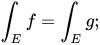
- Proposição
Sejam um espaço com medida e Se são funções mensuráveis então:

- Se e então
- Se q.s. em então
- q.s. em se, e somente se,





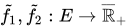
- Lema
Sejam um espaço com medida e uma função definida q.s. em Se e são redefinições de então

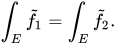
Agora já é possível definir a integral de funções definidas q.s. em
- Definição
...
Notas[editar | editar código-fonte]
Referências[editar | editar código-fonte]
Ver também[editar | editar código-fonte]

Índice remissivo

|
Faltam capítulos neste índice. |
Nesta página estão listados os conceitos abordados neste livro em ordem alfabética.
O nome de cada conceito possui um link para a página onde o mesmo é definido. Outras ocorrências importantes do conceito são indicadas pelos links numerados, logo após o link principal.
A[editar | editar código-fonte]
B[editar | editar código-fonte]
C[editar | editar código-fonte]
- conjunto
D[editar | editar código-fonte]
E[editar | editar código-fonte]
- Espaço
F[editar | editar código-fonte]
- Função
G[editar | editar código-fonte]
H[editar | editar código-fonte]
I[editar | editar código-fonte]
- Ínfimo
J[editar | editar código-fonte]
K[editar | editar código-fonte]
L[editar | editar código-fonte]
- Limite
M[editar | editar código-fonte]
N[editar | editar código-fonte]
O[editar | editar código-fonte]
P[editar | editar código-fonte]
Q[editar | editar código-fonte]
R[editar | editar código-fonte]
- Radon-Nikodin, teorema de
- Reta real estendida
S[editar | editar código-fonte]
T[editar | editar código-fonte]
- Teorema
- de Radon-Nikodin
U[editar | editar código-fonte]
V[editar | editar código-fonte]
W[editar | editar código-fonte]
X[editar | editar código-fonte]
Y[editar | editar código-fonte]
Z[editar | editar código-fonte]
Bibliografia
- de Barra, G.. Measure Theory and Integration. New Age International, 2008. 239 p. ISBN 0852261861
- Bartle, Robert Gardner. The Elements of Integration and Lebesgue Measure. Wiley, 1995. 192 p. ISBN 0471042226
- Borel, E. Leçons sur la théorie des fonctions. 1928. Gauthier-Villars et fils.
- Bourbaki, Nicolas. Intégration. Hermann, 1963.
- Cabral, Marco A. P.. Introdução à Teoria da Medida e Integral de Lebesgue. Rio de Janeiro: UFRJ, 2009.
- Courant, R. Kranzer, H.. Introduction to Mathematical Analysis. New York: New York University, Institute of Mathematical Sciences, 1954.
- Castro Jr., Augusto Armando de. Curso de Teoria da Medida. Rio de Janeiro: IMPA, 2004. 170 p. ISBN 8524402172
- DiBenedetto, Emmanuele. Real Analysis. Springer, 2002. 420 p. ISBN 0817642315
- Fernandez, Pedro Jesus. Medida e integração. 2ª.ed. Rio de Janeiro: IMPA, 2007. 198 p. ISBN 8524401052
- A parte inicial pode ser mais trabalhosa por envolver um pouco de Álgebra, mas o livro inclui diversos exercícios interessantes.
- Folland, Gerald B.. Real Analysis: Modern Techniques and Their Applications. 2ª.ed. 1999. 408 p. ISBN 0471317160
- Fremlin, David H. Measure Theory. Livro disponível sob os termos da DSL.
- Guzman, M. and Rubio, B. Integracion: teorıa y tecnicas. Alhambra, Madrid. 1979.
- Hewitt, E. A problem concerning finitely additive measures Mat. Tidsskr. B. 1951. p. 81-94.
- Halmos, Paul Richard. Measure Theory. Springer, 1974. ISBN 0387900888
- Este livro adota uma notação mais antiga.
- Honig, Chaim Samuel. A integral de Lebesgue e suas Aplicações. Rio de Janeiro: IMPA, 1977.
- Isnard, Carlos. Introdução à medida e integração. 1ª.ed. Rio de Janeiro: IMPA, 2007. 314 p. ISBN 9788524402708
- Lebesgue, Henri. Intégrale, longueur, aire. Annali di Matematica pura ed applicata, 1902. Springer.
- Lebesgue, Henri. Leçons sur l'intégration et la recherche des fonctions primitives. chelsea. 1973.
- Lang, Serge. Analysis I. 3ª.ed. Addison-Wesley, 1973. 460 p.
- Kasner, Edward, Newman, James Roy. Mathematics and the Imagination. Dover, 2001. 400 p. ISBN 0486417034
- Magalhães, Marcos Nascimento. Probabilidade e variáveis aleatórias. 2ª.ed. EdUSP, 2006. 411 p. ISBN 9788531409455
- Mikusinski, J. The Bochner Integral. Mathematische Reihe, 1978.
- Miraglia, F.. Tópicos de Análise. 2002. 546 p.
- Munroe, Marshall Evans. Introduction to Measure and Integration. 2ª.ed. Addison-Wesley, 1959. 310 p.
- Rana, Inder K.. An introduction to measure and integration. 2ª.ed. AMS Bookstore, 2002. 424 p. v. 45. ISBN 9780821829745
- Riesz, F. L'évolution de la notion d'intégrale depuis Lebesgue. Annales de l'institut Fourier 1 (1949), 29-42.
- Royden, M.. Real Analysis. New York: Collier Macmillan, 1988. ISBN 0024041513
- Rudin, Walter. Real and Complex Analysis. 3ª.ed. McGraw-Hill, 1987. 430 p. ISBN 0070542341
- Shilov, GE and Gurevich, BL and Silverman, R.A.. Integral, measure, and derivative; a unified approach. Prentice-Hall, 1966.
- Stone, M. H. Notes on integration. Proceedings of the National Academy of Sciences (1948).
- Yoshida, K., Hewitt, E.: Finitely additive measures. Trans. Amer. math. Soc. 72, 46–66 (1952).